
Blog
Discontinued Motorola Radio? Expert Replacement Options
Choose the Right Two‑Way Radio: FRS vs GMRS vs LMR, Made Simple
A small choice, massive consequences
Your loading dock is buzzing at 8:15. A picker calls for a lift, but the cheap FRS (Family Radio Service, unlicensed) handheld crackles; the forklift never hears it. Two pallets sit, a truck waits, tempers rise. Now picture the same moment with UHF (Ultra High Frequency) LMR (Land Mobile Radio, business-licensed) units: clean audio, instant confirm, pallets moving in 10 seconds. Same building. Same people. Different radios.
At your hotel, the front desk calls housekeeping on floor 12. The GMRS (General Mobile Radio Service, personal-license) handhelds fade through concrete; a family waits 14 minutes for a crib. With a simple repeater (a building signal booster) and discreet earpieces, the call lands first try and the crib arrives in 3. Your team looks calm. Your guests feel it. Not sure where to start? Chat with our radio specialists—no pressure.
FRS vs GMRS vs LMR: What Actually Fits Your Team
Before we pick and ship, you need a quick map of the radio landscape: FRS (Family Radio Service, no license, fixed antennas, low power), GMRS (General Mobile Radio Service, personal FCC license, higher power), and LMR (Land Mobile Radio, business-licensed). Choice affects range, interference, privacy, and growth. FRS is simple but limited. GMRS reaches farther but licensing complicates business use. LMR scales, adds repeaters, and keeps chatter down.
On a weekend hike with kids, FRS is fine across a campground. In a hotel with 12 floors of concrete, housekeeping needs business LMR to cut through walls and avoid guest chatter. A warehouse running forklifts all day? UHF (Ultra High Frequency) LMR handhelds with noise-canceling mics keep orders moving and hands free. GMRS can work for farms or family ranches, but businesses usually choose LMR for legal clarity, cleaner channels, and room to add repeaters.
Here’s how we guide every choice: coverage (how far through your terrain and buildings), capacity (how many people and talkgroups at once), and control (privacy, dedicated channels, and features like repeaters and encryption). Nail these and the brand, band, and budget fall into place. We’ll steer you in minutes.
Use this quick snapshot to anchor the differences before we compare details.
- FRS: License-free, low power, fixed antennas; short range for casual use or small, contained spaces.
- GMRS: Licensed, higher power, optional repeaters; extended range for families, ranches, or informal small groups.
- LMR: Professional, business-licensed systems; scalable coverage, privacy controls, repeaters, and commercial durability.
Where Good Teams Go Wrong With Radios
Those ‘up to 35 miles’ promises come from mountaintop tests, not your warehouse. Box specs list watts and channels, but concrete, steel, low‑e glass, and floor count decide coverage. We see crews buy consumer FRS because it’s cheap, then lose calls between aisles. Others grab GMRS for power, then discover the license is personal, not for their company. Your site rules, not the packaging.
Here are the traps we fix weekly—if you spot them early, you avoid re-buys and retraining.
- Range myths: Box says 35 miles; your campus with hills, buildings, and trees delivers 0.5–2 miles without a repeater.
- Power ≠ coverage: Antenna height, frequency band, and a well-placed repeater usually beat raw watts for real coverage.
- Crowded channels: Shared consumer bands invite interference and cross-talk; no privacy codes or licensing to keep others out.
- License fear: Business LMR licensing is straightforward and opens cleaner channels, repeaters, and higher reliability.
- Underestimating growth: Five users become 25; without channels, talkgroups, or a repeater, traffic collides and messages get lost.
These mistakes cost real money: missed work orders, delayed responses, safety near‑misses, and buying twice. Training time doubles when you rip and replace a fleet. Batteries die early on bargain units, and managers lose hours chasing dead zones. Spend five minutes on fit now to protect years of uptime, safety, and budget.
A Five‑Minute Radio Fit Check
Grab a notepad and jot quick answers. This isn’t homework—clarity here saves days of back‑and‑forth and prevents rework. We use these same questions on calls so we can recommend a setup in 3–10 minutes. If you’re unsure on any item, write a guess; we’ll validate it and fill the gaps.
Answer these five in order; your notes translate directly into the right service tier and gear.
Step 1: Coverage map: Mark max distance and note obstacles—walls, floors, steel, hills, foliage. Include buildings, basements, parking lots, and vehicles.
Step 2: User count & channels: List users and simultaneous talkgroups today, then estimate 12 months out. Note departments that need their own channel.
Step 3: Environment: Note noise, weather, dust, and hazards. Need intrinsically safe gear or heavy‑duty ratings like IP (Ingress Protection) and MIL‑STD‑810 (military durability tests)?
Step 4: Control & privacy: Decide if you need dedicated business frequencies, encryption, all‑call, and department talkgroups to cut cross‑talk and keep outsiders off your channels.
Step 5: Expandability: Flag future needs—repeaters for buildings/campuses, mobile radios for vehicles, dispatch or alarm integration, GPS and Man‑Down (fall detection), and easy interop with contractors.
FRS vs GMRS vs LMR: The At‑a‑Glance Decision
You just flagged expandability—repeaters, mobiles, dispatch—plus coverage, users, environment, and control. Now map those notes to each column below. License tells legality, Max Power and Repeaters drive coverage, Channels match departments, Typical Range sets expectations, Best For checks fit, and Cost frames budget. Skim left to right, circle the column that feels right, then we’ll fine‑tune in minutes.
| Service | License | Max Power | Channels | Repeaters | Typical Range | Best For | Approx Equipment Cost |
|---|---|---|---|---|---|---|---|
| FRS (Family Radio Service) | No license required | Up to 2W, fixed antenna | 22 shared channels | Repeaters not allowed | 0.5–2 miles typical, terrain dependent | Casual/personal use, very small on‑site teams | Lowest cost per radio |
| GMRS (General Mobile Radio Service) | FCC (Federal Communications Commission) license, no test | 5W handhelds; up to 50W mobiles | 30 total: 22 shared + 8 | Repeaters allowed | 5–25+ miles with repeaters, terrain dependent | Families, ranch/outdoor, off‑road, community groups | Moderate cost per radio |
| LMR (Land Mobile Radio, business/industrial) | FCC business/industrial license (Part 90) | Varies; 4–5W handhelds, higher‑power mobiles | Planned channels per license; talkgroups supported | Repeaters fully supported; standard for campuses | Site‑wide to multi‑site with repeaters | Professional operations, industrial, schools, hotels, campuses | Highest, but scalable |
Use FRS for light, short‑range, casual coordination. Choose GMRS if a licensed individual covers family/outdoor use and you want repeaters without business complexity. Pick LMR when you need privacy, cleaner spectrum, talkgroups, durability, and room to grow. Pivot to LMR if channels feel crowded, you require encryption, or coverage must span buildings. Not sure which column fits? We’ll recommend in 3 minutes, program your radios, and ship same‑day—with a 90‑day warranty and repair shipping included. Next, see the ready‑made recipes.
Your Ready‑Made Radio Setups by Scenario
You circled a column in the table—now turn it into gear. Here are quick recipes mapping FRS (Family Radio Service), GMRS (General Mobile Radio Service), and LMR (Land Mobile Radio) to real jobs, with add‑ons like repeaters (signal boosters), earpieces, and mobile radios. Pick your scenario, note headcount, and we’ll program it. Next, we’ll set real‑world range.
Scenario 1: Single building retail/floor staff: Start with FRS for tiny stores; choose entry LMR for cleaner channels, discreet earpieces, and better durability. 10–20 users, no repeater.
Scenario 2: Multi-floor hotel or hospital: LMR with an in‑building repeater for coverage and privacy; assign department channels, use discreet earpieces, and enable all‑call for emergencies.
Scenario 3: Warehousing and logistics campus: UHF LMR with dedicated channels; add noise‑cancelling speaker mics for forklifts. Use a repeater for >150k sq ft or multi‑building coverage.
Scenario 4: Off-road/overlanding caravan: GMRS with 50W mobiles and roof antennas for vehicles; handhelds for spotters. Program local repeater access where available for extended range.
Scenario 5: Community event or fairgrounds: Small events use GMRS; larger, multi‑vendor sites choose LMR with a repeater. Plan channels by role: ops, admissions, security, and emergency all‑call.
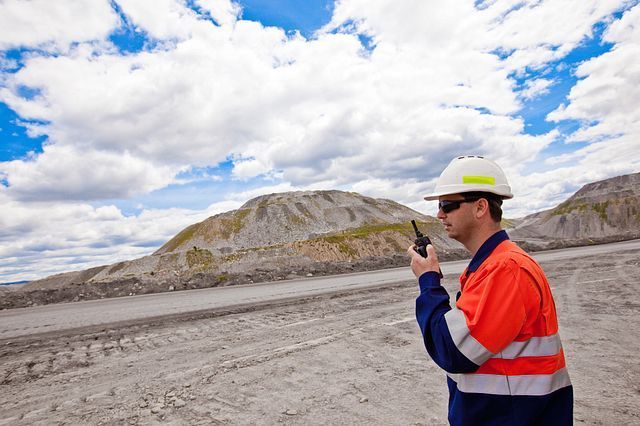
Scenario 6: Construction site with steel and concrete: Rugged UHF LMR, high‑capacity batteries, and speaker mics. Add a repeater for towers or basements; enable all‑call and lone‑worker features.
Forget “35 Miles”: Real Coverage Numbers
That steel-and-concrete jobsite you just pictured is exactly where range gets real. Radio waves prefer line-of-sight (clear path) and lose strength when they hit walls, metal, trees, or glass. Urban canyons (streets boxed by tall buildings) bend and block signals. Handhelds run 4–5 watts with tiny antennas. Mobiles in vehicles use roof antennas and higher power—often 25–50 watts—to punch farther and cleaner.
Those “up to 35 miles” claims? That’s mountaintop to mountaintop with zero obstacles. In the real world, a 200,000 sq ft warehouse with racking and forklifts needs a repeater to cover corners. A hotel with 12 concrete floors gets patchy on handhelds alone. Elevation wins: put the antenna higher and your footprint grows fast. Power helps, but placement and frequency band choices usually move the needle more.
To ground your expectations, here’s what most teams see day to day. Use these as planning baselines. Then we’ll decide if simplex (radio-to-radio) or a repeater fits your site.
- Dense indoor (steel/concrete): 0.25–0.5 mile per floor; repeaters often needed.
- Open suburban with light trees: 1–3 miles handheld-to-handheld.
- Ridge-to-valley line-of-sight: 5–10+ miles with mobiles; more with repeaters.
- Urban street level: Often under 1 mile without infrastructure.
Design Your System: Simplex, Repeaters, Handhelds, Mobiles
Under a mile without infrastructure? That’s simplex—radio‑to‑radio on one channel. We use it for small teams, single buildings, and events; it’s fast and cheap. When coverage must cross floors, steel, or a campus, add a repeater—an elevated relay that hears your handheld and re‑broadcasts it site‑wide. Handhelds (4–5 watts, short antennas) ride with people. Mobile radios (25–50 watts with roof antennas) live in vehicles or as a base to punch farther. Next, dial in comfort, audio, and battery uptime.
One well-placed rooftop unit can transform coverage. Our radio repeaters hear weak handhelds, then rebroadcast at full power from a high antenna, blanketing 200,000–500,000 square feet buildings or a multi-acre yard. Mount high, set the channel plan, and you’ll hear clean audio from basement to loading dock.
Accessories and Power: Comfort, Safety, All-Day Uptime
Now that your handhelds, mobiles, and even marine units are set, the next failure point is how you carry and power them. Accessories drive safety, comfort, and compliance; power planning keeps audio clean for 8–12 hour shifts and extends battery life. Choose the right earpieces, mics, and hazard-rated options, then set a simple charging routine. Next, we’ll tailor by industry.
Make radios easy to grab and hard to drop with carry accessories like holsters, chest packs, and belt clips. Example: managers keep hands free in retail, while forklift drivers secure units at chest level to avoid snagging. Comfort improves usage and safety.
Industry Playbooks: Match Radios to Your Environment
With your charging map dialed, what actually fits your environment? Here are field‑tested playbooks by industry so you can match class and form factor fast: GMRS (General Mobile Radio Service) for small, informal venues; LMR (business Land Mobile Radio) for professional operations with repeaters and talkgroups. Skim your vertical, note headcount, and we’ll handle licensing next.
- Warehousing & logistics: LMR with a role-based channel plan, noise‑canceling mics, and a repeater for >150k sq ft; explore warehouse radios.
- Aviation ground operations: Use aviation handhelds with high‑noise headsets and ramp‑safe carry; see aviation handheld radios for models that integrate with intercoms.
- Hospitality & events: GMRS for small venues; LMR with an in‑building repeater for hotels, arenas, or campuses with multiple floors.
- Construction & utilities: Rugged LMR, high‑capacity batteries, and noise‑canceling speaker mics; add a repeater for towers, basements, or large linear jobs.
- Marine operations: Prefer mobile radios with external antennas; use the marine mobiles mentioned earlier for salt, spray, and Coast Guard calling.
Licensing, Simplified: GMRS and LMR in Plain English
Coming from marine or hotel operations, next question is compliance. FRS (Family Radio Service) needs no license. GMRS (General Mobile Radio Service) requires one individual FCC (Federal Communications Commission) license covering their household for 10 years. LMR (business Land Mobile Radio) licenses the organization itself under Part 90 (FCC business/industrial rules)—cleaner channels, repeaters—and typically runs 10 years. We handle the process so your team stays legal and on the air.
Here’s the fast, no-exam GMRS path—most people finish in 10–15 minutes.
GMRS Step 1: Create an FCC CORES (account portal) login and get your FRN (FCC Registration Number) for payments and filings.
GMRS Step 2: Apply for the GMRS license in ULS (FCC’s Licensing System), pay the fee, and submit—no exam or frequency choice required.
GMRS Step 3: Receive your call sign, then program radios or confirm channels; most approvals post within minutes to a day.
GMRS Step 4: Share the call sign and rules with household members; your license covers spouse, kids, parents, grandparents, siblings.
For business LMR, we guide the Part 90 process—here’s the simple flow.
LMR Step 1: Define coverage, locations, and use cases—simplex (radio-to-radio) or repeater—plus user counts and departments.
LMR Step 2: Coordinate frequencies with an FCC-certified frequency coordinator to avoid interference and match your environment (UHF—Ultra High Frequency—indoors; VHF—Very High Frequency—open areas).
LMR Step 3: File the FCC application with selected frequencies, emission type (analog or digital), locations, antenna specs, and control points.
LMR Step 4: We program handhelds, mobiles, and repeaters; document channel names, emergency all-call, and encryption or privacy settings.
LMR Step 5: Train users, post radio etiquette and call signs, log licenses/renewals. Then we’ll map budget and total cost in the next section.
Budget and TCO: What You’ll Actually Spend
We just mapped licensing—now let’s put real numbers to your total cost of ownership (TCO). What will it actually cost to outfit your team? Use this table to ballpark equipment, license fees, and infrastructure, then adjust for accessories, building materials, headcount, and volume pricing. Example: a 20‑radio LMR fleet with one repeater often lands under a mid‑four‑figure budget. Share square footage and users; we’ll size it and quote fast.
| Service | Equipment Range (per unit) | License Fees | Infrastructure | Ongoing Costs | Notes |
|---|---|---|---|---|---|
| FRS (Family Radio Service) | Lowest cost handhelds, about $20–$60 each | No license required | None; repeaters not permitted | Batteries every 18–24 months; basic accessories | Best for tiny teams and very small areas |
| GMRS (General Mobile Radio Service) | Moderate: handhelds $70–$250; mobiles $150–$400 | FCC license fee: $35 for 10 years | Optional repeaters; community networks may exist | Batteries, antennas, occasional vehicle installs | Great value for ranches, off‑road, and families |
| LMR (Land Mobile Radio, business/industrial) | Pro handhelds $200–$700; mobiles $300–$800 | FCC Part 90 business license; coordination fees | Repeaters $1,500–$5,000; antennas, cabling, installation | Maintenance, training, battery refresh every 18–24 months | Scales for privacy, coverage, and multi‑building sites |
ROI comes from fewer missed calls, faster turns, and safer responses. Example: shaving 30 seconds off 200 calls a day saves 100 minutes of labor. Right‑sized LMR reduces interference, prevents re‑buys, and keeps teams compliant. Plan for batteries every 18–24 months and you’ll avoid downtime. Share headcount, square footage, and floors—we’ll deliver a tailored, same‑day quote.
Talk to a Radio Specialist in Minutes
You just shared headcount, square footage, and floors—perfect. We’ll turn that into a tailored radio plan in one quick call. With 15+ years of building systems, we program for your site and ship same‑day on most orders. You’re covered by a 90‑day warranty and free shipping on repairs. Want a fast, no‑pressure recommendation?
Give us 5–10 minutes and your five notes: coverage, users, environment, control, expansion. We’ll spec the exact kit—for example, 12 handhelds, one rooftop repeater, discreet earpieces—and email a clear quote you can approve today. Prefer chat or email? That works too. No pushy sales, just practical guidance and a same‑day path to reliable coverage.
- Fast, accurate recommendations based on your square footage, floors, and headcount.
- Channel plans, privacy/encryption, and repeater placement programmed for your exact site.
- Ongoing support from engineers, plus 90‑day warranty and free repair shipping.